

Part 3: Carbohydrate counting
Bilal's birthday cake has arrived in class, and Ayesha, who has type 1 diabetes, is sure it isn't for her. Her teacher has other ideas.
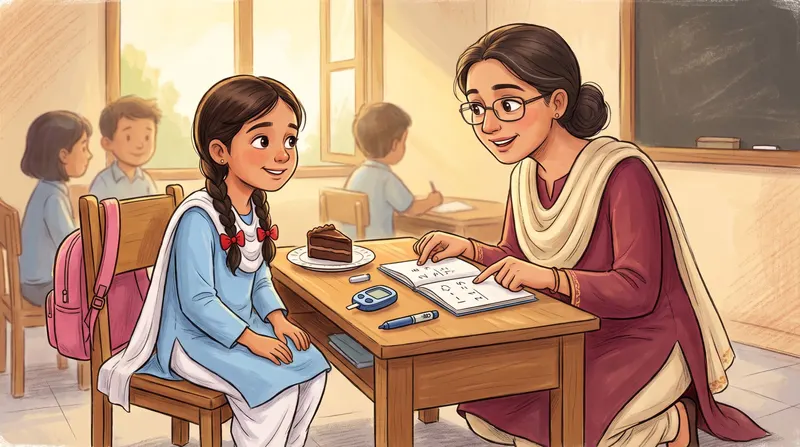



Ayesha is ten, and she has had type 1 diabetes since she was seven. Today is Bilal's birthday, and his mother has sent a chocolate cake to class.
Everyone crowds around the candles. Ayesha stays by her desk.
“I'll just watch. Cake isn't for me.”
“Who says? You can have cake with type 1 diabetes, Ayesha. You just count it, and cover it with insulin the way your plan says.”
“Step one: count the carbohydrate. One slice like this is about 30 grams.”
Carbohydrate is the part of food that turns into glucose, and it raises blood sugar faster and further than anything else.
“And if I want two slices?”
“Then add them up: 30 and 30 make 60 grams.”
How should Ayesha work out the insulin for 60 grams?
Tap an answer to see what happens.
AGuess: two slices, so a bit more than usual.
What happens instead
Your ratio, and any correction for high readings, has to come from your own diabetes team.
BDivide the carbs by the ratio on her care plan.
✓ The right step
“Your plan says 1 unit for every 15 grams. 60 divided by 15 is 4 units.”
That ratio is an example. Every child's ratio is different, and only their own diabetes team sets it.
CSkip the insulin and just have one bite.
What happens instead
“You don't need to miss out. Counting is exactly what lets you join in.”
Before the cake, Ayesha checks her sugar as her plan says, and Miss Farah watches her give the insulin.
“And we write it in your diary, so your mother knows tonight.”
Your ratio, and any correction for high readings, has to come from your own diabetes team.
“This isn't only for cake. It works for any food: pizza, biryani, a samosa. Three steps:”
2 slices of cake
3 slices of pizza (the box says 25 g a slice)
Count the carbs from the label or the carb counter, divide by the ratio on your own plan, and the answer is the number of units. Your diabetes team tells you how to round it, and what to change if your sugar is high or low before you eat.
Two slices, and a party she is part of.
“Best birthday ever, and it isn't even mine!”
Later, Miss Farah reminds her to check again as her plan says, and to keep fast sugar in her bag in case of a low:
Take 15 g of fast sugar: 3 teaspoons of sugar in water, or half a glass of juice or a regular cold drink.
What to remember
- Count the carbs first: one slice of cake like this is about 30 g, so two slices are about 60 g.
- People on mealtime insulin can match each dose to the carbohydrate they eat, using an insulin-to-carbohydrate ratio.
- Divide the carbs by the ratio on your own care plan. With the example ratio of 1 unit for every 15 g, 60 g needs 4 units.
- The same steps work for any food: 3 slices of pizza at 25 g each make 75 g, and 75 ÷ 15 = 5 units with the example ratio.
- Your ratio, and any correction for high readings, has to come from your own diabetes team.
- Tell your teacher, write it down, and keep fast sugar in your bag for a low.